《The Innovation Competitiveness of BRICS countries》 ——施普林格(SPRINGER)出版的第二部金砖创新智库报告
2025-10-09 00:00:00
浏览:
“
由丝路创新力咨询执行董事、中智联金砖科技创新服务中心理事长、国际欧亚科学院院士Zhao Xinli(赵新力), 俄罗斯国立研究型大学高等学校经济学院(HSE大学)教授Alexander Sokolov(亚历山大·索科洛夫), 巴西里约热内卢联邦大学经济学院教授José Eduardo Cassiolato(何塞·爱德华多·卡西奥拉托)主编,Springer Nature Singapore Pte Ltd.2025年4月份出版发行。
”
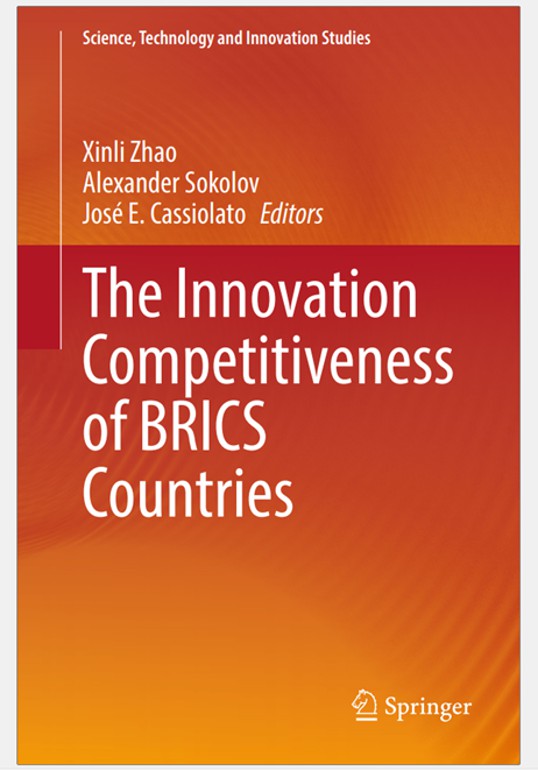
《The Innovation Competitiveness of BRICS countries》【ISSN 2363-6866, ISSN 2363-6874 (electronic), ISBN 978-981-97-8000-6 HARDCOVER,ISBN 978-981-97-8001-3 ELECTRONIC,ISBN 978-981-97-8002-0 SOFTCOVER,ISBN 978-981-97-8003-7 SOFTCOVER,ISBN 978-981-10-8077-7,ISBN 978-981-10-8078-4 (eBook) https://doi.org/10.1007/978-981-10-8078-4. 】由丝路创新力咨询执行董事、中智联金砖科技创新服务中心理事长、国际欧亚科学院院士Zhao Xinli(赵新力), 俄罗斯国立研究型大学高等学校经济学院(HSE大学)教授Alexander Sokolov(亚历山大·索科洛夫), 巴西里约热内卢联邦大学经济学院教授José Eduardo Cassiolato(何塞·爱德华多·卡西奥拉托)主编,Springer Nature Singapore Pte Ltd.2025年4月份出版发行。
巴西时间2025年6月12日下午,“新兴经济体科技创新和产业创新对话”在巴西里约热内卢温莎芭拉酒店如期举行。会上发布了《The Innovation Competitiveness of BRICS countries》。
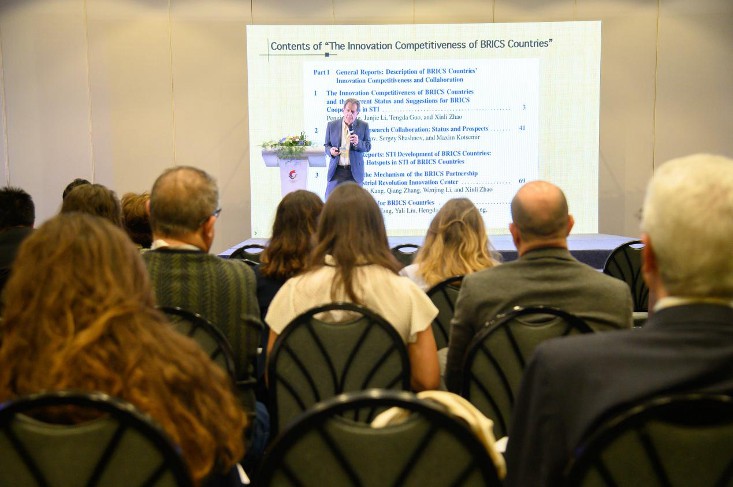
卡西奥拉托教授主持对话并和赵新力院士一起发布《The Innovation Competitiveness of BRICS Countries》
纽约时间2025年6月18日,联合国总部图书馆举办了国际欧亚科学院院士、丝路创新力咨询执行董事、中智联金砖科技创新服务中心赵新力博士向联合国图书馆捐赠学术著作的简短仪式。这是赵新力院士向该图书馆捐赠的第三批图书。受在欧洲出差的联合国图书馆馆长Giannakopoulos先生委托,Vakasisikakala女士(中)和Guevara先生(右)在联合国图书馆接受赠书并向赵新力院士(左)颁发证书。其中包括4月份刚刚出版发行的《The Innovation Competitiveness of BRICS countries》。

《The Innovation Competitiveness of BRICS countries》英文前言
The Innovation Competitiveness of BRICS Countries is the third book in English in the series on the comprehensive innovation competitiveness of BRICS countries.
Compared with the two previous editions published in 2018 and 2021, respectively, the main features of this book include the following: first, the five BRICS countries are placed among the 148 Belt and Road partner countries and 17 member countries of the Asian Infrastructure Investment Bank for assessment; second, the Partnership on New Industrial Revolution is used as the main logical line for comprehensive analysis and thematic reports; third, the country-based analysis is better organized for the convenience of country-to-country comparison.
The book concludes that from 2011 to 2021, the five BRICS countries embarked on different trajectories for changes in comprehensive innovation competitiveness: India registered the fastest increase, followed by Russia and South Africa. China saw modest improvement and Brazil experienced a decline. It is estimated that by 2030, the trend of comprehensive innovation competitiveness of BRICS countries will be further diverging, with India, Russia and China continuing to go up, Brazil possibly returning to the growth cycle, and South Africa facing an uncertain outlook.
BRICS countries should keep their focus on basic research, especially academic disciplines such as information science/digital economy, materials science, environmental science, energy, medicine, biotechnology, semiconductors and aerospace, which are important foundations for BRICS countries to deepen the Partnership on New Industrial Revolution. The BRICS Partnership on New Industrial Revolution is a holistic and future oriented major initiative. It charts a new course for the second Golden Decade of BRICS cooperation. To foster such a partnership, BRICS countries need to explore new models to improve domestic circulation efficiency through international circulation and promote openness and development across the innovation chain from scientific research, technology development and engineering to commercialization.
BRICS countries should make use of cyber physical system (CPS)-related technology to drive industrial transformation, leverage the unique strengths of each in production and innovation systems, and foster more growth drivers through science, technology and innovation (STI). BRICS countries should increase technology development and application in priority areas, establish a BRICS technology bank, and accelerate the development of a BRICS intellectual property network. BRICS countries should facilitate the development of a top BRICS STI think-tank, put in place a regular mechanism on innovative talent exchange and improve BRICS governance system.
To establish an innovation base for BRICS Partnership on New Industrial Revolution
is an important initiative to deepen pragmatic BRICS cooperation in trade and investment, digital economy, STI, energy and climate change. BRICS countries need to launch projects on comprehensive platforms, for instance, STI bases & centers, educating and training system and services in accordance. BRICS countries should uphold multilateralism, diversify cooperation models and enable multiple participation, and improve information sharing platform, network-based platforms for service system and talent exchange, and STI cooperation environment.
From 2007 to 2021, all five BRICS countries have notably improved their level of informatization, and the average level of information and communication technology (ICT) in BRICS countries exceeded the global average in 2015. According to ICT Development Index (IDI) released by ITU, Russia and Brazil started early in ICT development among the five countries, while China has been making rapid progress over the past decade, with the fastest growth in the ICT application index; Russia is leading by a big margin in the ICT skills index.
Technology transfer has played a positive role in the advance of STI in BRICS countries. The proposed efforts include: strengthening the building of the BRICS Technology Transfer Center, facilitating cooperation in areas of technology vital to the Partnership on New Industrial Revolution, exploring industry standards and international mechanisms applicable to BRICS countries, and promoting models of technology transfer driven by the demand side of technologies.
The book concludes that in recent years, Brazil has launched a series of reform initiatives on the science and technology system and achieved significant progress in areas including life sciences, epidemic prevention and control, artificial intelligence, aerospace and polar research. Brazil attaches high importance to international cooperation and has carried out fruitful science and technology cooperation under multilateral and bilateral frameworks. Russia enjoys a strong foundation for STI development. The Russian government attaches great importance to science and technology and the role of science and technology in supporting economic and social development. Russia’s R&D investment has seen steady growth, and research institutions and research outputs including papers and PCT patents have kept growing. Notable progress has been made in biomedicine, advanced manufacturing, aerospace,
and high-energy physics. India has great potential and space for STI development. With the support of the government, India’s STI capacity has continued to improve, and its R&D output has registered sustained growth. India is a world leader in information technology, biomedicine, aerospace, energy and other fields of science and technology. China is accelerating an innovation-driven development strategy and has joined the ranks of innovative countries. STI has empowered its high-quality development, providing strong support to economic growth, social progress, a better life, national security and the addressing of major challenges such as COVID-19; STI has contributed to China’s poverty eradication, rural revitalization and the building of a moderately prosperous society. The South African government attaches great importance to STI and is harnessing the power of STI in developing the “digital economy” and “bio-economy”, driving poverty reduction, employment and social equality, and promoting inclusive growth and sustainable economic and social development. South Africa has made significant progress in the fields of astronomy, paleoanthropology, aerospace, biomedicine, and advanced manufacturing.










联系我们
电话:13380606131
地址:珠海市横琴濠江路1566号1栋511办公
邮箱:slchxl@sirinnovation.com
网址:www.sirinnovation.com